2026 Health Seminar - Genetic Testing
with Kari Ekenstedt
April 24, 2026
About Me


DNA is Amazing!
DNA makes up who you are!
-
What makes you human, what makes your dog a dog, and part of what makes all of us a little different
DNA is an incredible way to store information – one we’ve not been able to replicate artificially
-
Average mammalian genome is about 2.5-3 billion base pairs (2.5-3 Gb)
-
Average mammalian genome codes for 20,000 genes
Genes Typically Come in Pairs
This is because normal mammals (and some plants) have two sets of chromosomes.
-
Normally, every chromosome has a pair
-
Typically, each gene has two copies
Is That Disease/Trait/Condition Inherited or Not?
This can be tricky.
Example: Cataracts
-
Several forms of hereditary cataracts exist
-
But cataracts can also occur from injury, toxin, or disease (like diabetes)
Things to consider:
-
Age the disorder becomes evident
-
Whether or not littermates or other relatives are affected
-
Is it known to occur in the breed?

Human karyotype
Single Gene Disease
-
A mutation (or variation, or a change) in just one gene can result in disease
-
Hundreds have been described and solved in dogs
-
Ditto for people
Mutations (changes) occur every single generation as eggs and
sperm are produced
-
Usually neutral, sometimes good, sometimes bad
-
This is not anybody’s fault – natural process
-
Our cellular machinery just occasionally makes istakes when copying!
-
Recessive Trait/Disease
Autosomal recessive inherited diseases are the most common type of single-gene disorders in dogs
Usually from inbreeding
-
(Note: we would not have purebred dogs without SOME inbreeding – so care has to be taken with inbreeding!)
-
In this scenario, an affected dog must inherit two copies of the mutant allele, one from each parent, to have the disorder/altered phenotype
-
“Allele” = Version of a gene
Dog with one copy (“carrier”) or with two copies of the normal allele will have the normal trait (no disease)
As long as the frequency of the mutant allele for a disorder is low, it can lurk in a breed for many generations...
…Only to appear when two carriers are mated (by chance) and affected individuals are observed in a litter. Sometimes this is multiple generations away from where the mutation first occurred.
Frequency of the mutant allele can become very high in these scenarios
-
Popular sire effect
Hard to eradicate without a genetic test
-
Carriers are clinically normal
Dominant Trait/Disease
Here, only one copy of the mutant allele is required to show the trait or disease
These are much rarer compared to recessive
Examples:
-
Black Mask
-
Cataract
NOT Single-Gene Disease…
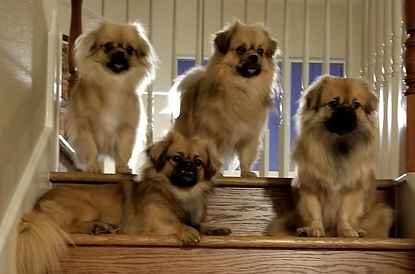
Many genetic diseases and conditions are NOT single- gene!
-
Dogs: hip dysplasia, cranial cruciate ruptures, idiopathic epilepsies
-
Called “polygenic” or “complex” disease
Multiple – sometimes hundreds – of genetic loci can contribute to a disease (or trait)
-
Dog that likes water/swimming!

The Million Dog Paper (2023)
-
250 total single-gene tests
-
39 Tibetan Spaniels tested

PRA (Progressive Retinal Atrophy) Type 3
In the “Million Dog” paper: of 39 Tibbies tested, one was heterozygous (allele frequency: 1.35%) for PRA Type 3
Sample size is small, so the true (current) breed frequency isn’t fully defined
Original paper published in 2014: 14.7% carriers and 85.3% homozygous wild type (clear)
-
Breed frequency likely changing over time….hopefully decreasing slowly as people select away from it
PRA Type III, FAM161A-related
Loss of vision due to death of cells in the retina (back of the eye) – can be rods or cones or both
Leads to vision loss and eventually blindness
Clinical Picture in Tibbies
-
Clinically indistinguishable from other forms of PRA
-
Age at diagnosis is relatively late (~5 years of age), but broad, and could actually be younger
FAM161A gene has a mutation
-
(Large insertion near exon 5 splice site)
-
Autosomal recessive, fully penetrant
-
Breeding considerations
-
Consider individual health (puppies you are creating)
-
Consider breed health (the breed as a whole)
-
-
Laboratories

Autosomal Recessive: Breeding Recommendations
The “E” allele is recessive, and represents the mutated version of FAM161A.
The “N” allele is the dominant allele, and represents the normal, fully functional version of FAM161A. Hypothetical offspring are in the middle four boxes
Take-Home Message with Hypothetical Matings
-
All potential matings are shown for a single-gene, recessive condition like PRA Type 3
-
Do not do any of the crosses that produce red puppies (they will become blind)
-
This is considering individual dog health
-

-
It is OKAY to do matings that make purple (carrier) puppies, because those puppies are not affected and we want to preserve as much of the genetic diversity of the breed as possible.
-
So, it is OKAY to use carriers in matings, as long as you’re breeding to a clear.
Always retain the best, and eventually the best will also be clear for PRA Type 3
If you immediately remove all carriers from the breed, you’ll toss out a lot of other good genetics that should be retained
This is considering population health of the whole breed
Other things to note:
-
The IDENTICAL FAM161A mutation is present in the Tibetan Terriers (It was not found in Lhasa Apsos)
-
In both Tibetan Spaniels and Tibetan Terriers PRA Type III, FAM161A-related is probably not the only form of PRA (Heterogeneity exists – not all cases were explained by this mutation)
-
English Shepherds have PRA from a DIFFERENT mutation in the same FAM161A gene
-
Genetic testing for the English Shepherd FAM161A variant is not useful in the Tibbies
-
CDDY - IVDD
From the "Million Dog" paper
-
CDDY-IVDD
-
Not the same as CDPA
Chondrodysplasia (CDPA)
CDPA = “breed-defining chondrodysplasia”
-
FGF4 on CFA18 (retrogene insertion)
-
Shortened long bones in the legs
-
Early closure of growth plates
-
No known negative health effects
-
Co-dominant (one copy = milder change, two copies = more extreme change)
Tibetan Spaniel DOES have this mutation


CDDY (also called: CDDY-IVDD)
-
CDDY: Chondrodystrophy
-
IVDD: Intervertebral Disc Disease
-
CDDY with IVDD risk is also from an FGF4 retrogene insertion, but on CFA12
-
Also co-dominant (one copy = milder limb shortening; two copies = more dramatic limb shortening)
-
Effects on the limbs are milder than CDPA
-
Having the CDDY variant creates some increase to head width
-
ALSO has effects on the discs in the spine
-
Because CDDY is DOMINANT then having just one copy of CDDY means the dog’s discs are not normal (note that this is different than in recessive diseases)
Intervertebral Discs
Just like in humans, discs are cushions between the bones (vertebrae) of the spine
Disc disease in dogs can be broken into two groups:
-
Hansen’s Type 1: younger dogs, typically dogs with shorter legs; bony calcification of the discs and multiple affected discs
-
Hansen’s Type 2: older dogs, larger breeds, typically just 1-2 discs affected

The CDDY mutation is present in most of the dogs with Hansen’s Type 1 IVDD
-
Degeneration and calcification of the disc (IVDD)
-
Predisposes the dog to herniation of the disc
-
Painful, can be life threatening
-
The disc (or part of the disc) bulges into or presses into the spinal cord, compressing it
-
What signs the dog shows will depend on what level of the spine the disc herniates at and how much the spinal cord is compressed.
-
Surgery can decompress the spinal cord, medical management sometimes used (case-by-case basis)
-
Screening x-rays can sometimes see narrowed disc spaces and/or calcification of the discs
-
-
With either one or two copies of the CDDY mutation, the dog is more likely to experience premature degeneration and calcification of the intervertebral disc
-
Co-Dominant mode of inheritance
-
High risk of herniation
-
BUT…herniation is not guaranteed (although the discs are not normal) because environment can influence, too
-
Discs can also herniate away from the spinal cord – and these dogs might not have signs at all
-
Signs of disc herniation (into spinal cord)
-
Back pain: stiffness, arched back, shaking/shivering, muscle spasms, hesitation to move, vocalization when touched
-
Lameness, limb weakness, knuckling of the paws when walking, incoordination when walking, or paralysis
-
Can also see fecal and/or urinary incontinence
Tibbies and CDDY
-
In the million dog paper, 39 Tibbies were tested (78 copies) (~12% allele frequency)
-
9 copies were “alternate” (the mutated version)
-
-
Wisdom Panel data (publicly available, separate data set): 100-500 dogs tested, 8% allele frequency
Recommendations
Keep body weight lean and keep muscles healthy (uphill walks, swimming)
-
Avoid high-impact movements that twist or compress the spine
-
Ramps for older dogs to get up into car, onto couch/bed, etc.
Keep nails short!
Breed screening via radiograph? No published research on what the clinical picture looks like in Tibbies specifically
Breed away from CDDY? Yes, but SLOWLY!
-
Favor one-copy at-risk dogs (over two-copy at-risk dogs)
-
Probably best to avoid breeding dogs with many calcified discs on x-ray


Degenerative Myelopathy (DM)
-
In the Million Dog paper, 39 Tibbies tested had an 11.5% allele frequency of the SOD1 mutation
-
This mutation has ONLY been validated in breeds like the Corgi and German Shepherd
-
DM can only be diagnosed at postmortem exam (by looking at the spinal cord under a microscope)
-
-
Tibetan Spaniels not affected with DM as far as I can find in the scientific literature…
-
…so this test is irrelevant in the breed
-
Familial Dilated Cardiomyopathy and Sudden Cardiac Death

-
Missense variant published in 2019 in the Doberman Pinscher
-
In the Million Dog paper, one Tibbie was a carrier for this mutation
-
It is autosomal dominant, but has incomplete penetrance
-
This variant has NOT been validated in the Tibbie breed
-
-
So we truly do not know if it means anything in this breed
-
If anyone has a Tibbie with this variant that does die suddenly from cardiac death – let me or another dog genetic researcher know about it!
What to do if something comes up?
An example in another breed: Basset Hounds
-
Two littermates died ~6 months apart
-
Died unexpectedly between 3-4 years of age
-
Necropsies performed and the pathologist diagnosed a glycogen storage disease
-
These are usually genetic, so the pathologist contacted me
-
-
Tibetan Spaniels not affected with DM as far as I can find in the scientific literature…
-
…so this test is irrelevant in the breed
-

Summary of What We Did with the Basset Hounds
-
We whole genome sequenced the two affected dogs
and their unaffected sire -
We identified the causative mutation
-
It is an autosomal recessive, single-gene disease
-
-
We developed a genetic test and offered it to the public
-
This all happened so quickly that the national breed
club didn’t even know it was an issue yet in the breed-
We caught it before it spread widely
-
This saved untold numbers of dogs from dying and the heartache it would have caused to the breeders and owners
-
-
This is a best case scenario success story, and took breeders, researchers, and clinicians all coordinating together

Breeder Role
Round-up samples
-
Contact puppy owners
-
Encourage submission
-
Cases and controls (affected and unaffected) are needed
Funding options?
-
Ostrich behavior will probably be worse in the long run
-
Patience
-
Projects don’t always work out immediately, or ever
-
The disease may not be single-gene
-
Note that we NEVER breach confidentiality – your name, your dogs’ names, your kennel name, etc., will NEVER be shared or published in any way
What's Next?
-
If researchers are very, very sure they have the causative mutation identified
-
Offer test OR license test to commercial company
-
Possibly present the work at a scientific conference
-
Speak at appropriate National Specialty to share with breeders!
-
-
Publish paper – this is the scientific review
-
After that…the test will likely be picked up by many commercial testing companies
-
Summary
-
Single-gene diseases are the “lowhanging” fruit
-
Complex/polygenic diseases are a lot harder
-
-
New ones are going to keep popping up
-
Because of dog breed structure and because our genomes change every generation
-
-
The science is a fascinating process, but it cannot be done without teamwork and the help of breeders
Monitoring Breed Health
Breed health databases are VITAL for tracking health information in a breed
-
Use the Tibetan Spaniel Health Net
-
Update with pedigrees and health information
-
It is vital that you include both breeding animals AND pets
-
Encourage all your pet owners to participate!
-
-
Helps identify problems, trends, and can catch new diseases as they pop up (because they will)
-
For example: Which cancers are most prevalent?
-
-
Other health screening is also super important
-
Elbows, Hips, CAER (formerly called CERF) exams, patellas, etc.
-
Questions?
-
Contact Information: Kari Ekenstedt
Email: kje0003@purdue.edu

